Integrated Livestock Farming
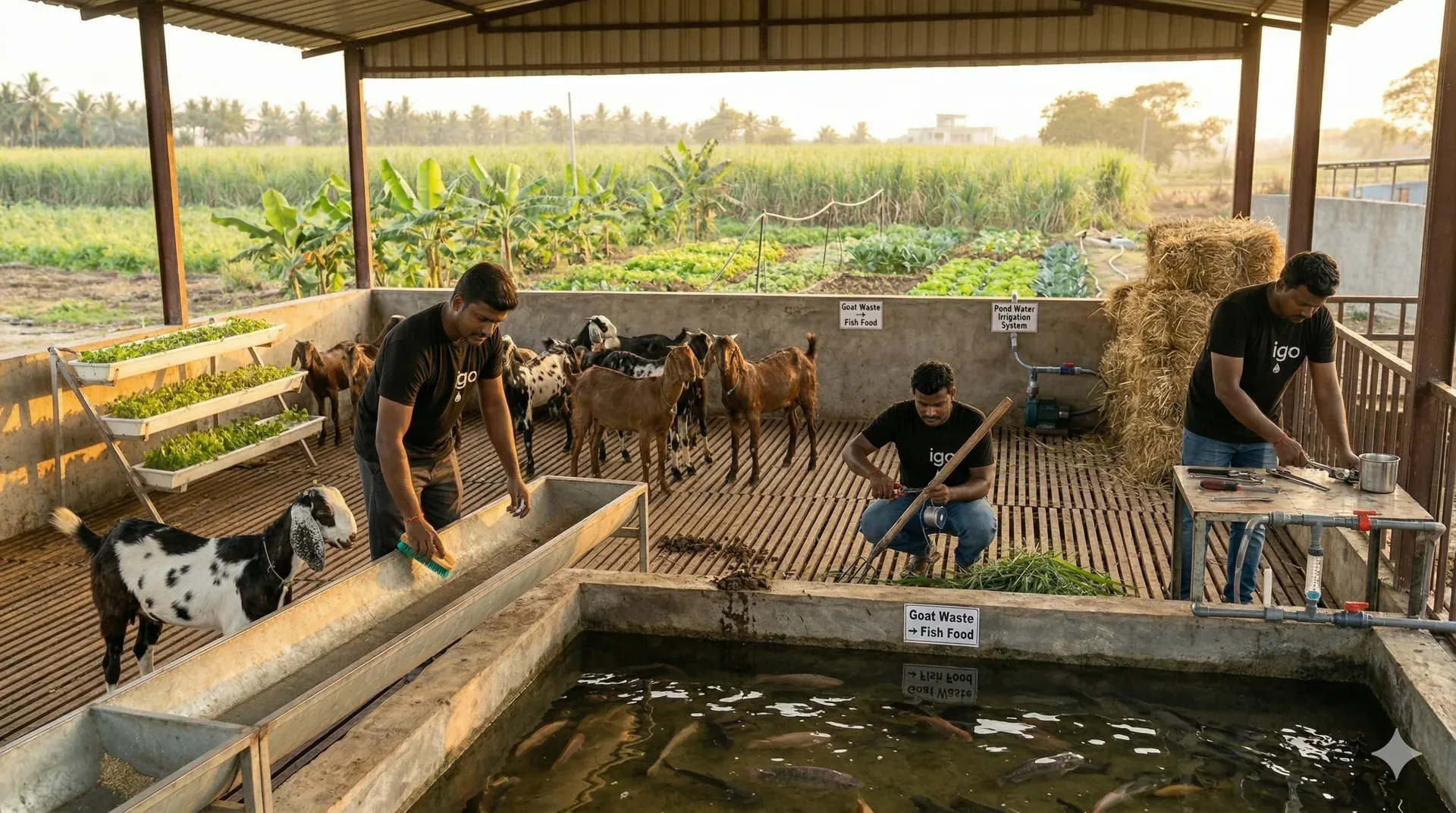
Goat + Fish Farming
We handle breed consultation, shed construction with ventilation systems, feed infrastructure, veterinary tie-ups, and full operational handover.
- Goat shed constructed over fish pond for space efficiency
- Goat droppings supplement fish nutrition — reduces feed cost
- Dual income from fish, milk & meat on same land
- Water quality maintained via natural biofloc formation
- Widely practiced integrated model in coastal Andhra Pradesh
Site Survey
Comprehensive land assessment, soil or water analysis, and engineering feasibility report.
Turnkey Setup
End-to-end installation by expert teams using institutional-grade, certified materials.
Training
Hands-on operational training covering system management, crop protocol, and troubleshooting.
AMC Support
Annual maintenance contracts ensuring long-term performance, yield consistency and uptime.
Our Workflow
Professional
Turnkey Workflow
Technical Feasibility
Rigorous site assessment and precision engineering design tailored to your land, climate, and budget.
Expert Installation
Professional on-site execution using certified materials, precision equipment, and our trained field teams.
Handover & Training
Comprehensive handover documentation, operational training, and long-term AMC support for sustained performance.
Guaranteed structural integrity — institutional grade, 10+ years lifespan
IGO Advantage
15,000+
Projects Delivered
Market Focus
ROI First
Every project designed for maximum commercial viability
Scalable from pilot units to full commercial enterprise
More from Integrated Livestock Farming
Related Projects
In-Depth Guide
Goat and Fish Farming in India: How One Farm Can Use the Same Space for Livestock and Aquaculture
What if the space occupied by a goat shed could also become part of a fish-production system?
That is the basic idea behind integrated goat and fish farming.
Instead of allocating completely separate areas for livestock and aquaculture, goat and fish farming in India can combine the two activities through intelligent farm design.
A goat shed can be constructed over or alongside a fish pond, allowing the same farm area to support two production activities. Manure generated by the goats can also become part of the nutrient cycle associated with fish production when managed according to the system protocol.
This makes the project more than a goat farm beside a pond.
It becomes one vertically integrated livestock and aquaculture system.
Start by Looking at the Farm Vertically
Most agricultural planning happens horizontally.
One section is allocated to livestock. Another becomes the fish pond. Another may be reserved for feed storage or other activities.
An integrated goat-fish system introduces another possibility: using vertical space.
IGO Agritech Farms' current project model includes a goat shed constructed over the fish pond for space efficiency.
This allows livestock housing and aquaculture to occupy connected production space rather than requiring completely separate footprints.
For projects where land utilization matters, this approach can create a very different farm layout.
The Goat Shed Is More Than Livestock Housing
The upper livestock section still needs to function as a proper goat-management facility.
Goats require suitable housing, ventilation, feed infrastructure, drinking water and access for workers.
The shed should allow routine activities such as feeding, animal inspection, cleaning and veterinary management.
At the same time, its position relative to the pond changes how waste needs to be managed.
The structure therefore has two responsibilities:
Support the Goat Herd + Integrate Safely with the Fish Pond
Engineering, animal management and aquaculture planning need to be considered together from the beginning.
The Pond Becomes the Second Production Level
Below or beside the livestock section is the aquaculture component.
The fish pond is not simply a place where farm waste is deposited.
It is a biological production environment.
Fish require appropriate water conditions, stocking density, oxygen, nutrition and monitoring.
The pond should therefore be designed according to the selected fish-production protocol.
Depth, water source, drainage, pond dimensions and operational access all need to be considered.
Integrated farming works only when both components remain productive.
Follow the Nutrients from Goat to Fish
One of the defining features of IGO's goat-fish model is nutrient recycling.
Goats consume feed and generate manure.
IGO states that goat droppings can supplement fish nutrition within the integrated system, helping reduce dependence on external fish feed.
The basic relationship becomes:
Goat Feed → Goat → Manure → Pond Nutrient Cycle → Fish Production
This is what makes the system integrated rather than simply two farming activities sharing the same property.
However, nutrient input needs control.
More manure does not automatically mean more fish production.
Manure Is a Resource Only When It Is Managed
Integrated farming depends on balance.
Organic material entering the pond influences water conditions and biological activity.
Too much nutrient loading can create water-quality problems rather than production benefits.
The system therefore needs a defined manure-management protocol based on pond capacity, fish stocking and water conditions.
Farm operators should monitor the aquatic environment and make management decisions according to actual pond conditions.
The objective is controlled nutrient recycling—not uncontrolled waste disposal.
Natural Biofloc Adds Another Biological Process
IGO's project page highlights natural biofloc formation as part of water-quality management in its goat-fish system.
Biofloc refers to communities of microorganisms and organic particles that develop under suitable aquatic conditions.
These biological processes can influence nutrient cycling within the pond.
This creates another layer of integration:
Goat Manure → Pond Nutrients → Microbial Activity → Aquatic Production System
The exact biological balance depends on water conditions, organic loading, aeration and farm-management practices.
Operators therefore need to understand that the pond is a living ecosystem, not simply a water-storage area.
Oxygen Still Matters
Whenever nutrients and organic material enter an aquaculture system, oxygen management becomes important.
Fish require adequate dissolved oxygen.
Microbial activity also consumes oxygen.
The farm should therefore consider aeration according to the pond design, fish biomass and operating conditions.
Farm workers should observe fish behaviour and water conditions regularly.
An integrated biological system can be efficient, but it also means activities in one section can influence conditions in another.
Feeding Becomes a Two-Part Strategy
Integrated goat and fish farming requires two feeding programmes.
The goat herd needs a balanced livestock-feeding plan according to breed, age and production stage.
The fish require nutrition according to species, stocking and growth stage.
Nutrients contributed through goat manure may supplement the pond system, but they should not automatically be treated as a complete replacement for professionally planned fish nutrition.
The farm needs to understand what comes from outside and what is recycled internally.
That is where integration can become measurable.
Water Quality Connects the Entire Aquaculture Operation
The pond needs routine water-quality management.
Farm operators should follow appropriate protocols for parameters relevant to the selected fish species and production system.
Visual observation is useful, but commercial aquaculture should not depend only on the appearance of the water.
Changes in fish behaviour, oxygen conditions or pond biology can indicate that the system requires attention.
Water management becomes especially important because livestock-generated nutrients are intentionally connected with the aquaculture component.
Separate Animal Health from Pond Management
Integration does not mean removing hygiene boundaries.
Goats still require vaccination, veterinary care, clean drinking water and appropriate shed hygiene.
Fish require their own health and water-management protocols.
IGO's project scope includes veterinary tie-ups for the livestock section.
The farm should maintain separate health records for goats and production records for fish while connecting the information needed for overall farm management.
A problem in one production area should not be allowed to become a problem throughout the system.
Two Production Activities Need Two Calendars
Goats and fish operate on different biological timelines.
Goat breeding, kidding, growth and health management follow one schedule.
Fish stocking, feeding, biomass development and harvesting follow another.
A useful integrated calendar might track:
Goat Feeding → Manure Generation → Pond Management → Fish Stocking → Fish Growth → Goat Breeding → Fish Harvest → Livestock Market Movement
The cycles do not need to finish at the same time.
The objective is to understand how they interact throughout the year.
One Property Can Produce Multiple Outputs
IGO describes its goat-fish model as creating outputs from fish, milk and meat on the same land, depending on the livestock production model.
This diversification is one of the key characteristics of integrated farming.
But every output still requires a market.
Fish buyers may be different from livestock buyers.
If milk forms part of the selected goat-production model, it creates another market channel with its own handling requirements.
The farm should therefore develop production and market plans together.
Measure Whether Integration Is Actually Working
Good records can show whether the combined system is delivering practical operational benefits.
A farm can monitor:
Goat Population → Feed Use → Manure Generation → Pond Condition → Fish Feed → Fish Growth → Livestock Output → Fish Harvest
Over time, this information helps operators understand how efficiently resources move between the two sections.
Without measurement, an integrated farm can easily become two separate businesses that happen to share the same location.
Why This Model Can Suit Limited Farm Space
One of the most interesting characteristics of goat-fish farming is its use of space.
Constructing livestock infrastructure in connection with the pond can reduce the need to allocate completely independent areas to both activities.
That does not mean every property is suitable for the model.
Land conditions, pond feasibility, water availability, structural engineering, livestock requirements and environmental management should all be evaluated first.
A professional site assessment is therefore particularly important before deciding on the final configuration.
Developing Goat + Fish Farming with IGO
IGO Agritech Farms provides end-to-end support for Goat + Fish Farming projects in India.
The project begins with a comprehensive site survey covering land assessment, soil or water analysis and engineering feasibility.
IGO's project scope includes breed consultation, goat shed construction with ventilation, feed infrastructure, veterinary tie-ups and complete operational handover.
The integrated system is then planned around the relationship between livestock housing and fish production.
Hands-on operational training and long-term AMC support are also available.
Produce More from the Same Farm Footprint
Goat and fish farming demonstrates that agricultural diversification does not always mean dividing land into more sections.
Sometimes the solution is to connect production vertically.
The goats occupy a professionally designed livestock environment. The pond below or alongside supports aquaculture. Properly managed manure becomes part of the nutrient cycle. Fish convert the aquatic production environment into another marketable farm output.
For entrepreneurs exploring goat and fish farming in India, the central planning question is therefore:
“Can the same farm space support two compatible production systems?”
When structural design, goat management, manure control, pond biology, water quality and fish production are professionally coordinated, the answer can be yes.
The result is not simply a goat shed above a fish pond.
It is one farm designed to make livestock, nutrients, water and space work together.
Planning a Goat + Fish Farming Project? IGO Agritech Farms provides support for site assessment, goat shed construction, feed infrastructure, veterinary coordination, pond integration, operational planning, training and ongoing technical assistance.
Next Step
Ready to start your
Goat + Fish Farming project?
Get a free site assessment, detailed project report, and cost estimate from IGO's engineering team.