Goat Farming
Commercial Goat Farming
We handle breed consultation, shed construction with ventilation systems, feed infrastructure, veterinary tie-ups, and full operational handover.
- Breed selection: Boer, Sirohi, Black Bengal based on region
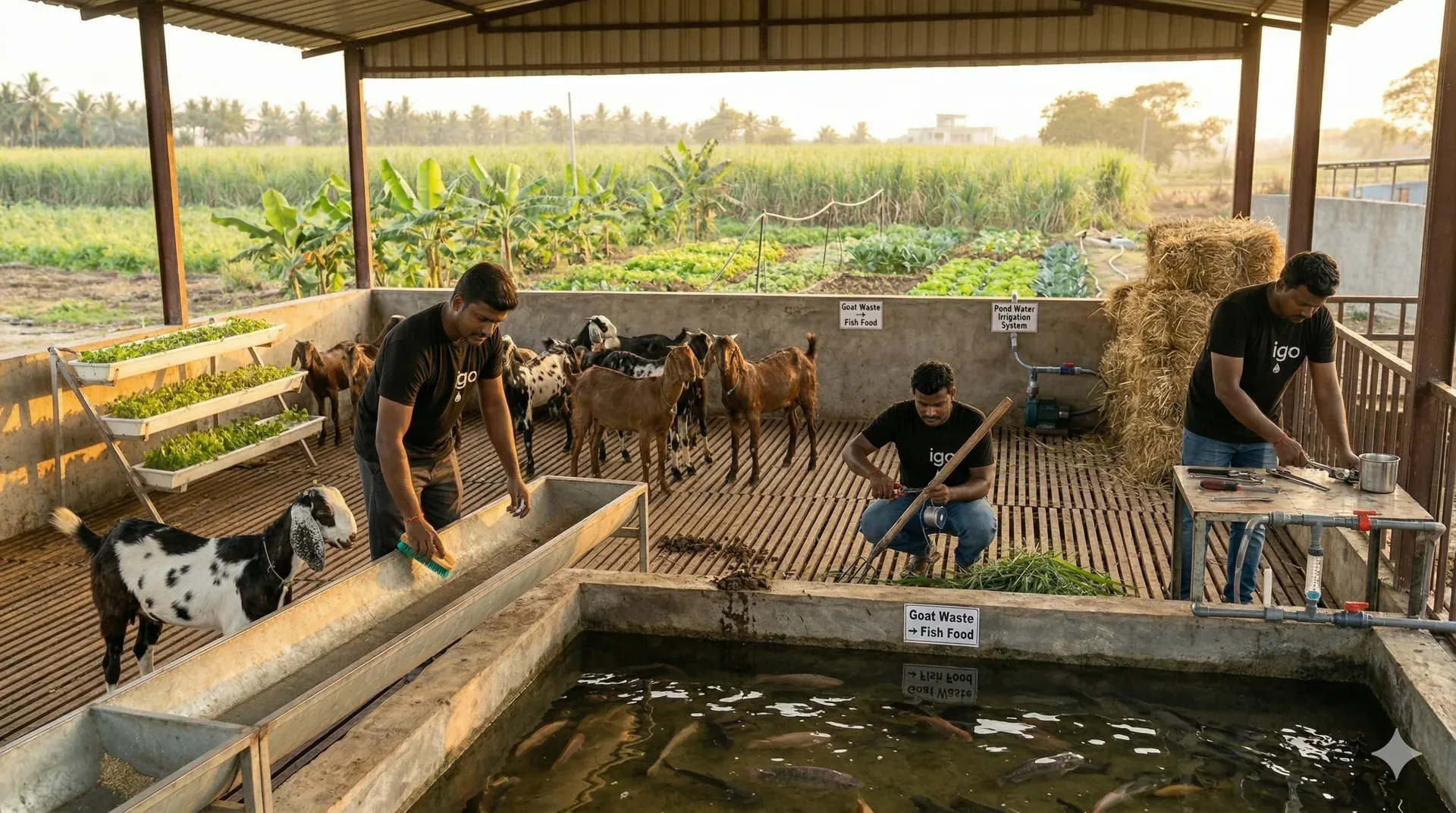
- Shed design: well-ventilated, slatted floor for hygiene
- 20–50 goat capacity to 500+ animal commercial units
- Breeding, health management & vaccination schedule included
- Subsidy under National Livestock Mission — up to 25%
Site Survey
Comprehensive land assessment, soil or water analysis, and engineering feasibility report.
Turnkey Setup
End-to-end installation by expert teams using institutional-grade, certified materials.
Training
Hands-on operational training covering system management, crop protocol, and troubleshooting.
AMC Support
Annual maintenance contracts ensuring long-term performance, yield consistency and uptime.
Our Workflow
Professional
Turnkey Workflow
Technical Feasibility
Rigorous site assessment and precision engineering design tailored to your land, climate, and budget.
Expert Installation
Professional on-site execution using certified materials, precision equipment, and our trained field teams.
Handover & Training
Comprehensive handover documentation, operational training, and long-term AMC support for sustained performance.
Guaranteed structural integrity — institutional grade, 10+ years lifespan
IGO Advantage
15,000+
Projects Delivered
Market Focus
ROI First
Every project designed for maximum commercial viability
Scalable from pilot units to full commercial enterprise
More from Goat Farming
Related Projects
In-Depth Guide
Commercial Goat Farming in India: Building a Farm That Grows with the Herd
A commercial goat farm should not be designed only for the number of animals it has on the first day.
The herd changes.
Young animals grow, breeding produces new kids, different groups require separate management, and feeding and healthcare requirements increase as the farm expands.
This makes commercial goat farming in India as much about farm planning as animal rearing.
A professionally designed goat farm connects breed selection, shed capacity, ventilation, hygiene, feeding, breeding and healthcare into one operating system that can develop with the herd.
Start with the Purpose of the Farm
Before constructing the shed or purchasing animals, the commercial objective should be clear.
The farm may focus on breeding, meat production or another planned production model.
That decision influences breed selection, herd structure, housing requirements and operational planning.
The available land, climate, feed availability, labour and local market should also be considered.
Starting with the production objective prevents the farm from becoming a collection of animals without a clear management system.
Select the Breed for the Region
IGO Agritech Farms identifies Boer, Sirohi and Black Bengal among the breeds considered for its commercial goat farming projects.
Breed selection should not be based only on popularity.
Regional climate, production objective, availability of suitable breeding stock, management capacity and market demand all matter.
Sirohi and Black Bengal, for example, have different characteristics, while Boer is widely associated with meat-oriented goat production.
The farm needs animals that fit its environment and commercial objective rather than selecting a breed first and trying to adapt the entire farm around it later.
Design the Shed Around the Animals
Housing is one of the most important pieces of infrastructure on a commercial goat farm.
IGO's project model uses well-ventilated sheds with slatted flooring for hygiene.
A shed should provide adequate protection while allowing good airflow.
Ventilation becomes particularly important when many animals are housed within the same facility.
The structure should also make everyday activities practical.
Feeding, cleaning, animal inspection, movement and veterinary access all need to be considered during the layout stage.
A goat shed is not simply a roof over the herd. It is the centre of daily farm operations.
Slatted Flooring Supports Hygiene Management
Floor design influences how easily the housing environment can be maintained.
Slatted flooring can help separate animals from manure and waste, supporting a cleaner living area when the system is properly designed and maintained.
But flooring should also be appropriate for animal movement and the overall shed design.
Routine cleaning remains necessary.
The goal is to create an environment where waste management is built into the infrastructure instead of depending entirely on manual correction after hygiene problems develop.
Divide the Herd into Management Groups
A growing goat farm should not necessarily keep every animal together.
Different groups may have different requirements.
A commercial layout can consider separate areas for breeding animals, pregnant does, kids, growing animals and animals requiring observation or treatment.
This makes feeding and health monitoring easier.
It can also reduce unnecessary movement and competition between animals of different sizes.
As herd numbers increase, organized grouping becomes increasingly important.
Good farm design therefore begins with understanding how animals will move through different life stages.
Build Feeding Infrastructure for Daily Efficiency
Feed is a recurring requirement throughout the life of the farm.
IGO includes feed infrastructure within its commercial goat farming project scope.
The layout should allow feed to be stored, handled and distributed efficiently.
Feeding areas should also be designed so animals can access feed appropriately without unnecessary wastage or competition.
The production plan needs to consider the availability of green fodder, dry fodder, concentrates and other nutritional requirements according to the farm's feeding protocol.
A commercial goat farm should know not only how many animals it can house, but also how those animals will be fed every day.
Plan Water Alongside Feed
Reliable access to clean drinking water is equally important.
Water points should be positioned so goats can access them easily while allowing workers to inspect and maintain the system.
Poorly located water facilities can create unnecessary wet areas inside housing sections.
The farm layout should therefore coordinate feeding, drinking and drainage rather than treating each as an independent feature.
Small infrastructure decisions repeated across hundreds of animals can have a major impact on daily labour.
Breeding Needs a Calendar
IGO's commercial goat farming model includes breeding management.
Commercial breeding should be planned rather than left entirely to chance.
Farm records can track breeding animals, mating dates, expected kidding periods and offspring.
This helps the team prepare appropriate spaces and management requirements for pregnant animals and newborn kids.
Over time, breeding records can also provide useful information about herd performance.
The commercial herd becomes easier to manage when every important stage has a record and expected timeline.
Kid Management Shapes Future Herd Size
Newborn and growing kids represent the future production capacity of the farm.
Their management therefore deserves dedicated attention.
Farm teams should follow suitable protocols for early care, feeding, observation and health management.
Kids may also need to be grouped according to age or development stage as they grow.
If the farm plans to expand through its own breeding programme, kid survival and development become directly connected with future herd numbers.
Expansion is not simply about buying more goats.
It can also be built systematically through better herd reproduction and young-stock management.
Vaccination Should Follow a Schedule
Animal healthcare should be preventive wherever possible.
IGO includes health management and vaccination schedules within its commercial goat farming model.
A farm should maintain records for vaccinations, veterinary observations, treatments and other relevant health activities.
New or sick animals may also require separate management according to the farm's veterinary protocol.
IGO additionally includes veterinary tie-ups as part of its project approach.
This helps connect infrastructure with professional animal-health support.
On a commercial farm, health management becomes a herd-wide system rather than an occasional response to individual animals.
Design for 50 Goats and Think About 500
One of the strongest features of IGO's model is scalability.
The company's current project page states that farms can range from approximately 20–50 goat capacity to commercial units with 500+ animals.
That does not mean every farm should immediately begin with hundreds of goats.
It means the initial layout should consider what happens if the herd expands.
Future sheds, feed storage, animal movement, waste management, water infrastructure and access routes can be considered during the original master planning.
This reduces the risk of expansion creating a poorly organized farm later.
Records Turn Animals into a Managed Herd
As numbers increase, memory is no longer enough.
A practical goat farm can track:
Animal ID → Breed → Age → Breeding → Kidding → Vaccination → Health → Growth → Sale
Records help farmers understand what is happening across the herd.
They can also support better decisions about breeding, replacement animals and production planning.
Commercialization begins when the farmer moves from managing individual goats informally to managing the entire herd systematically.
Government Support May Be Available
IGO's current project page identifies Commercial Goat Farming as government-subsidy eligible and mentions support under the National Livestock Mission.
The page indicates assistance of up to 25%.
Actual subsidy availability, percentage, eligible project components and approval will depend on current scheme guidelines, applicant category, location and competent authority approval.
Entrepreneurs should verify the latest official requirements before including subsidy assistance in their project planning.
Developing Commercial Goat Farming with IGO
IGO Agritech Farms provides end-to-end support for Commercial Goat Farming projects in India.
The project begins with technical feasibility and site assessment based on the available land, climate and project requirements.
IGO's scope includes breed consultation, shed construction with ventilation systems, feed infrastructure, veterinary tie-ups, breeding and health-management planning.
The company also provides professional installation, operational training, handover documentation and ongoing AMC support.
Projects can be planned from smaller commercial units to larger farms according to site conditions and operational capacity.
Build for the Herd You Want to Manage Tomorrow
Commercial goat farming is not simply about purchasing goats and constructing a shed.
It is about creating a system capable of managing animals through breeding, birth, growth, healthcare and eventual market movement.
The breed determines part of the production strategy. The shed creates the living environment. Feeding and water infrastructure support daily operations. Breeding creates the next generation, while vaccination and veterinary management help protect the herd.
For entrepreneurs exploring commercial goat farming in India, the most useful planning question may therefore be:
“Will the farm I build today still work when my herd becomes larger tomorrow?”
When the answer is yes, the farm has been designed not simply to hold goats, but to support a growing commercial livestock operation.
Planning a Commercial Goat Farming Project? IGO Agritech Farms provides support for breed consultation, shed design and construction, feeding infrastructure, breeding and health-management planning, operational training and ongoing technical assistance.
Next Step
Ready to start your
Commercial Goat Farming project?
Get a free site assessment, detailed project report, and cost estimate from IGO's engineering team.