Goat Farming
Integrated Goat Farming
We handle breed consultation, shed construction with ventilation systems, feed infrastructure, veterinary tie-ups, and full operational handover.
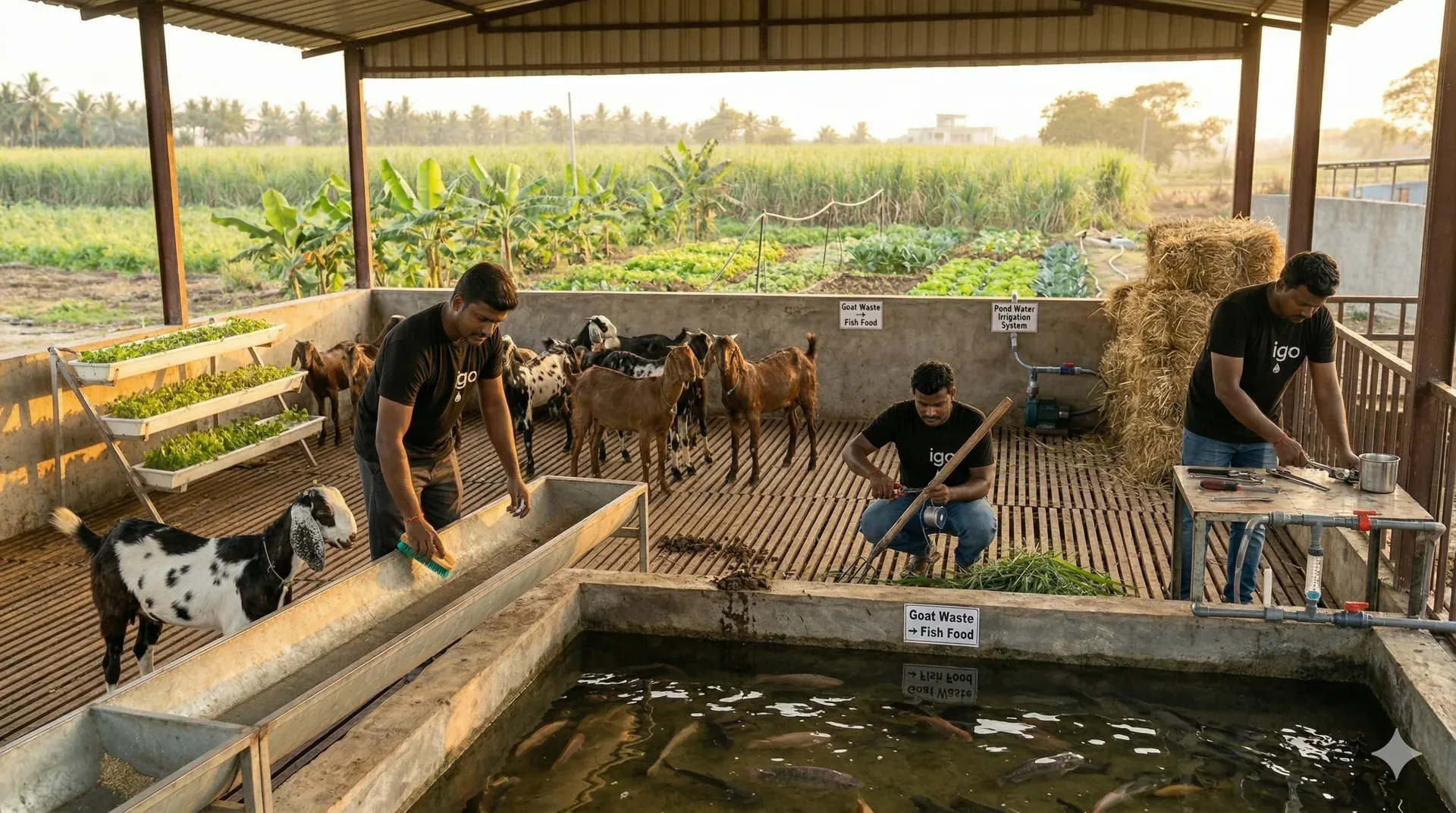
- Goat farming combined with crop production on same land
- Goat manure improves soil fertility — reduces fertiliser cost
- Stall-fed & semi-grazing systems designed per land availability
- Dual income: milk, meat & manure for crop farms
- Training in integrated farm management included
Site Survey
Comprehensive land assessment, soil or water analysis, and engineering feasibility report.
Turnkey Setup
End-to-end installation by expert teams using institutional-grade, certified materials.
Training
Hands-on operational training covering system management, crop protocol, and troubleshooting.
AMC Support
Annual maintenance contracts ensuring long-term performance, yield consistency and uptime.
Our Workflow
Professional
Turnkey Workflow
Technical Feasibility
Rigorous site assessment and precision engineering design tailored to your land, climate, and budget.
Expert Installation
Professional on-site execution using certified materials, precision equipment, and our trained field teams.
Handover & Training
Comprehensive handover documentation, operational training, and long-term AMC support for sustained performance.
Guaranteed structural integrity — institutional grade, 10+ years lifespan
IGO Advantage
15,000+
Projects Delivered
Market Focus
ROI First
Every project designed for maximum commercial viability
Scalable from pilot units to full commercial enterprise
More from Goat Farming
Related Projects
In-Depth Guide
Integrated Goat Farming in India: Turning Livestock and Crops into One Productive Farm System
A goat farm produces more than livestock.
Every day, animals consume feed, generate manure and require land, water and labour. At the same time, agricultural land needs nutrients, crop planning and organic matter.
Integrated goat farming in India connects these activities instead of managing them separately.
Goats can be raised alongside crops or fodder production. Manure generated by the herd can become a useful farm resource, while suitable crops can support the livestock-feeding system.
The result is a farm where livestock and agriculture become parts of one operating cycle.
What Makes Goat Farming “Integrated”?
IGO Agritech Farms describes Integrated Goat Farming as goat farming combined with crop production on the same land.
This is different from simply having a goat shed somewhere on an agricultural property.
In an integrated model, the livestock and crop sections are deliberately planned to support the overall farm.
Land can be divided according to animal housing, fodder production, commercial crops, manure management, water infrastructure and operational access.
The objective is to make better use of the resources already moving through the farm.
Follow the Nutrient Cycle
One of the easiest ways to understand integrated goat farming is to follow the nutrients.
Crops and fodder grow on the farm.
Suitable plant material contributes to the livestock-feeding programme.
Goats consume feed and produce manure.
That manure can be properly collected and managed before being incorporated into crop-production practices.
The cycle becomes:
Crops & Fodder → Goat Feed → Manure → Soil → Crops & Fodder
This circular relationship gives integrated farming its unique character.
Instead of treating manure only as waste, the farm recognizes it as a resource that can be managed productively.
Goat Manure Can Support Soil Fertility
IGO specifically highlights that goat manure can improve soil fertility and help reduce fertiliser costs within the integrated system.
Manure contains organic matter and nutrients that can contribute to soil management when properly collected, processed and applied.
However, manure should not simply be moved directly from the shed to crops without a plan.
Storage, composting or other appropriate handling practices may be required according to the farming protocol.
Application should also consider the crop, soil condition and nutrient requirements.
The objective is efficient nutrient recycling—not uncontrolled manure application.
Plan Fodder as Part of the Farm
Feed is one of the most important recurring requirements in goat farming.
An integrated project can allocate suitable land for fodder production depending on available space, climate, water and herd size.
This changes the role of agricultural land.
Instead of purchasing every feed component from outside the farm, part of the livestock requirement can potentially be supported through planned fodder cultivation.
The exact feeding programme should still follow the nutritional requirements of the animals.
Farm-grown fodder becomes one component of a professionally planned feeding system rather than the only feed source.
Match the Rearing System to Available Land
IGO's project page supports both stall-fed and semi-grazing systems, selected according to land availability.
These two models create different farm layouts.
In a stall-fed system, animals spend more time within managed housing and feed is brought to them.
A semi-grazing system may combine housing with controlled access to suitable outdoor areas.
Neither model should be selected simply because it appears easier.
Land size, vegetation, labour, herd numbers, climate, feeding strategy and operational control should determine which approach is appropriate.
Design the Goat Shed as Part of the Whole Farm
The livestock shed should not be planned in isolation.
Its location can influence animal movement, feed transport, manure collection, water supply and access to crop or fodder areas.
IGO's project scope includes shed construction with ventilation systems and feed infrastructure.
A good integrated layout can create shorter and more practical movement routes.
Feed comes toward the livestock section.
Manure moves toward the collection and crop-management section.
Workers need clear access between these areas.
Farm layout therefore directly influences daily operating efficiency.
Create a Manure Management Zone
Integrated goat farms benefit from having a defined area for manure handling.
Waste collected from animal housing should move through an organized process rather than accumulating around the shed.
The farm can plan space for collection and appropriate processing according to its manure-management protocol.
From there, the material can be allocated to suitable agricultural sections.
This creates traceability.
Farm managers can understand approximately how much manure is being generated and where it is being used.
As herd numbers increase, organized manure management becomes increasingly important.
Crops Should Match the Farm Objective
Integrated farming does not mean every available piece of land needs to grow the same crop.
Different areas can have different purposes.
Some land may support fodder production.
Other areas may produce commercial crops based on soil, water availability, climate and market demand.
The balance depends on the farm's primary objective.
A livestock-focused farm may allocate more land toward supporting the herd, while another project may combine goat production with a stronger commercial crop component.
Integration should follow the available resources rather than forcing every farm into one standard layout.
Water Planning Connects Livestock and Agriculture
Both goats and crops require reliable water.
The farm therefore needs to understand total water demand before expansion.
Drinking-water infrastructure for animals should remain clean and accessible.
Crop and fodder areas may require their own irrigation strategy.
Storage, pipelines, drainage and irrigation should be planned as connected infrastructure wherever practical.
This becomes increasingly important during dry periods when both livestock and crop production may depend on the same water source.
Integrated farming works only when shared resources are planned for the complete system.
Keep Crop and Herd Calendars Together
Crops follow planting and harvesting schedules.
Goats follow breeding, kidding, vaccination and growth schedules.
An integrated farm needs both calendars.
For example, fodder production should be scheduled according to expected herd requirements rather than planted without considering when the feed will actually be needed.
Similarly, manure availability can be connected with crop and soil-management schedules.
A combined calendar might track:
Fodder Planting → Feeding → Breeding → Kidding → Manure Collection → Crop Nutrition → Crop Harvest
This helps different farm activities support one another at the right time.
Integrated Farming Still Requires Animal Healthcare
Combining goats with crop production does not reduce the importance of livestock health management.
IGO's project approach includes veterinary tie-ups along with operational planning.
Vaccination, observation, treatment and breeding records should remain part of regular herd management.
Housing hygiene is equally important.
Manure recycling should never mean allowing waste to remain around animals unnecessarily.
The manure needs to move efficiently from the livestock environment into the appropriate management process.
Healthy integration depends on maintaining clear hygiene standards.
One Farm Can Produce Multiple Outputs
IGO highlights multiple potential outputs from the integrated model, including meat, milk and manure for crop farms.
The actual output mix will depend on breed, farm model and commercial objective.
Crop or fodder production creates additional agricultural activity on the same property.
This diversification can reduce dependence on a single farm output, but each product still needs its own production and market plan.
Integration should create operational value—not unnecessary complexity.
Records Show Whether Integration Is Working
Farm records can connect livestock and crop activities.
A useful system can track:
Herd Size → Feed Requirement → Fodder Production → Manure Generation → Crop Application → Crop Output
Animal records can separately cover breeding, kidding, vaccination, growth and movement.
Over time, these records help farmers understand whether the different parts of the farm are actually supporting one another.
Without records, “integration” can easily become several unrelated activities happening on the same land.
Developing Integrated Goat Farming with IGO
IGO Agritech Farms provides end-to-end support for Integrated Goat Farming projects in India.
The process begins with technical feasibility and a comprehensive site survey covering land assessment, soil or water analysis and engineering requirements.
IGO's scope includes breed consultation, ventilated shed construction, feed infrastructure, veterinary tie-ups and operational handover.
The project model can be designed around stall-fed or semi-grazing systems depending on available land.
Hands-on training in integrated farm management is also included, along with ongoing technical and AMC support.
Make the Farm Feed Itself More Efficiently
Integrated goat farming is ultimately about connecting resources.
The crop section produces biomass. The herd converts feed into livestock production and manure. Properly managed manure returns nutrients and organic matter to agricultural land. Fodder production can then continue as part of the next cycle.
Nothing operates completely independently.
For entrepreneurs considering integrated goat farming in India, this creates a different planning question from conventional commercial goat farming:
Instead of asking only how many goats the land can hold, ask how efficiently the land, crops, fodder, livestock and manure can work together.
When those elements are planned as one system, integrated goat farming can turn a livestock property into a more diversified and resource-efficient agricultural farm.
Planning an Integrated Goat Farming Project? IGO Agritech Farms provides support for site assessment, breed consultation, shed construction, feed infrastructure, crop and fodder integration, veterinary coordination, operational training and ongoing technical assistance.
Next Step
Ready to start your
Integrated Goat Farming project?
Get a free site assessment, detailed project report, and cost estimate from IGO's engineering team.