Farm Infrastructure Projects
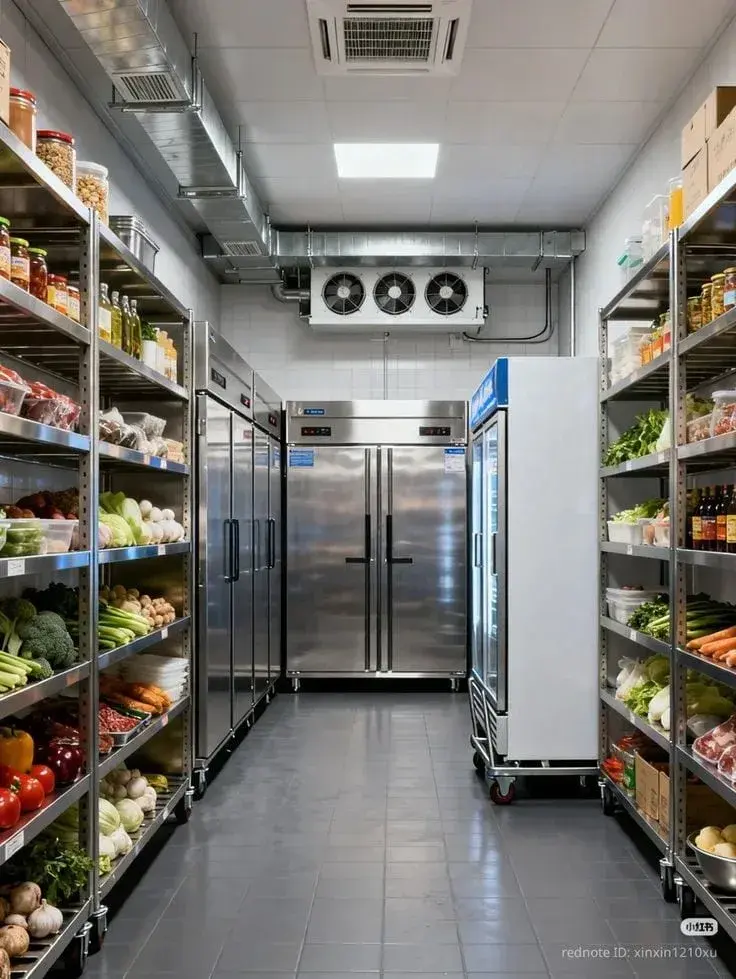
Cold Storage
We manage civil and structural engineering, certified material procurement, on-site precision execution, and commissioning with full documentation.
- Insulated PUF panel construction for temperature uniformity
- Capacity: 10 MT to 5,000 MT as per client requirement
- Temperature range: -25°C to +10°C multizone options
- Energy-efficient reciprocating & screw compressor units
- Subsidy under NHM — up to ₹35/MT capacity for horticulture produce
Site Survey
Comprehensive land assessment, soil or water analysis, and engineering feasibility report.
Turnkey Setup
End-to-end installation by expert teams using institutional-grade, certified materials.
Training
Hands-on operational training covering system management, crop protocol, and troubleshooting.
AMC Support
Annual maintenance contracts ensuring long-term performance, yield consistency and uptime.
Our Workflow
Professional
Turnkey Workflow
Technical Feasibility
Rigorous site assessment and precision engineering design tailored to your land, climate, and budget.
Expert Installation
Professional on-site execution using certified materials, precision equipment, and our trained field teams.
Handover & Training
Comprehensive handover documentation, operational training, and long-term AMC support for sustained performance.
Guaranteed structural integrity — institutional grade, 10+ years lifespan
IGO Advantage
15,000+
Projects Delivered
Market Focus
ROI First
Every project designed for maximum commercial viability
Scalable from pilot units to full commercial enterprise
More from Farm Infrastructure Projects
Related Projects
In-Depth Guide
Cold Storage Project in India: Protecting Agricultural Produce Beyond the Harvest
Harvesting a good crop is only one part of agricultural production.
What happens after harvest can be equally important.
Fresh fruits, vegetables and other temperature-sensitive products continue to undergo biological and physical changes after they leave the farm. If storage conditions are unsuitable, product quality can deteriorate before the produce reaches its intended buyer.
This is where a professionally engineered cold storage project in India becomes an important part of agricultural infrastructure.
Cold storage creates a controlled environment between production and market, helping businesses manage temperature-sensitive produce through a planned post-harvest system.
The Harvest Is Not the End of the Production Chain
Agricultural planning often focuses heavily on what happens before harvest.
Farmers select crops, prepare land, manage irrigation, provide nutrition, monitor crop health and organize harvesting.
But commercial agriculture continues after the crop leaves the field.
Produce may need to move through:
Farm → Collection → Sorting → Storage → Transport → Wholesale/Retail/Processing
Cold storage can become an important link within this chain.
Instead of treating storage as a separate warehouse activity, it should be planned according to the type of produce, expected volume, holding period and intended market.
Start with the Product, Not the Building
A cold storage project should not begin by asking:
“How large should the building be?”
The first question should be:
“What are we storing?”
Different agricultural and food products can require different storage conditions.
Temperature requirements, storage duration, packaging, humidity, airflow and product movement can vary considerably.
A cold-storage facility therefore needs to be engineered around its intended products.
The building comes after the storage requirement is understood.
Temperature Is the Core Production Parameter
IGO Agritech Farms' Cold Storage project offers a temperature range from -25°C to +10°C, with multizone options.
This wide operating range allows projects to be configured for different storage applications depending on technical requirements.
A multizone facility can create separate temperature-controlled sections rather than forcing every stored product into one common environment.
This becomes useful when a commercial operation handles different product categories.
The required temperature for each commodity should always be determined according to appropriate post-harvest and food-storage recommendations.
Why Multizone Storage Matters
Imagine a storage business handling several agricultural products.
Not every product necessarily belongs in exactly the same temperature environment.
A multizone cold-storage facility allows the building to be divided according to storage requirements.
Instead of thinking of the project as one large cold room, it can be viewed as several controlled environments inside one infrastructure system.
That means capacity planning should consider not only total tonnage but also how much space each product category requires.
The internal zoning strategy can therefore be just as important as the overall building capacity.
PUF Panels Help Create the Thermal Envelope
IGO's cold-storage infrastructure uses insulated PUF-panel construction for temperature uniformity.
Insulation is a fundamental part of cold-room engineering.
The refrigeration system works to create the required internal temperature, while the insulated structure helps separate that environment from external conditions.
Walls, ceilings, doors and joints therefore need to work together as a thermal envelope.
A cold storage facility should not be viewed as a normal warehouse with refrigeration equipment added later.
The building itself is part of the temperature-control system.
Temperature Uniformity Matters Across the Room
Achieving the required temperature at one sensor location is not enough.
Stored products may occupy racks, pallets or designated floor areas throughout the room.
The refrigeration and airflow design should therefore aim to maintain appropriate conditions across the usable storage zone.
Poor product stacking or blocked airflow can also affect performance.
Cold-room operation consequently depends on both engineering and day-to-day storage practices.
Facility design should make proper product movement and airflow easier to maintain.
Capacity Should Follow Commercial Requirement
IGO currently offers cold-storage capacities ranging from 10 MT to 5,000 MT, depending on client requirements.
This allows projects to be planned for very different operating scales.
But bigger is not automatically better.
Capacity should be based on realistic product movement.
A commercial assessment can consider:
Daily Incoming Produce → Maximum Storage Requirement → Average Holding Period → Outgoing Volume → Seasonal Peak
These numbers help determine how much storage capacity the operation actually requires.
Building unused capacity increases infrastructure that still needs to be operated and maintained.
Plan for Seasonal Peaks
Agricultural supply is not always uniform throughout the year.
Harvest seasons can create periods when large quantities of produce arrive within a relatively short time.
Cold-storage planning should therefore examine peak requirement rather than only average monthly volume.
A facility that performs comfortably during normal periods may experience operational pressure when incoming volume rises sharply.
Receiving areas, internal movement, storage zones and dispatch operations should all be considered when planning capacity.
Refrigeration Equipment Drives the System
IGO's cold-storage projects include energy-efficient reciprocating and screw compressor units.
Compressors are central components within refrigeration systems.
The appropriate system should be selected according to project capacity, temperature requirement, operating pattern and engineering design.
Equipment selection should not happen independently of the building.
Insulation, refrigeration load, storage volume, door usage and external conditions can all influence system requirements.
Cold storage is therefore an engineering project in which multiple components need to be designed together.
Energy Efficiency Begins with Design
Cooling a commercial storage facility requires energy.
That makes energy efficiency an important operational consideration.
Efficiency is not determined by the compressor alone.
Insulation quality, equipment sizing, temperature settings, door management, product loading and maintenance can all influence energy consumption.
A well-designed facility aims to maintain the required storage conditions without unnecessary cooling losses.
Operational discipline is equally important.
Leaving doors open unnecessarily or operating poorly maintained equipment can reduce the benefit of good engineering.
Product Movement Needs Its Own Workflow
Produce needs to enter and leave the facility efficiently.
A practical cold-storage layout can consider:
Receiving → Inspection → Pre-Storage Handling → Cold Room → Retrieval → Dispatch
The exact stages will depend on the facility.
Movement routes should minimize unnecessary handling and avoid creating congestion.
This becomes increasingly important as storage capacity grows.
A 5,000 MT facility requires a very different logistics plan from a 10 MT unit.
The building should therefore be designed around both temperature and movement.
Monitoring Protects the Storage Environment
A commercial cold-storage operation should maintain systematic records.
Useful information may include:
Room → Product → Batch → Quantity → Entry Date → Temperature → Storage Period → Dispatch Date
Temperature monitoring is especially important.
If storage conditions move outside the required operating range, the farm or facility team needs to identify and investigate the issue.
Monitoring therefore provides both operational information and a historical record.
Maintenance Protects Uptime
Cold storage depends on equipment operating reliably.
Compressors, refrigeration components, electrical systems, insulated doors and monitoring equipment all require inspection and maintenance.
Preventive maintenance can help identify issues before they create longer interruptions.
IGO provides Annual Maintenance Contract support as part of its project offering.
For commercial facilities, maintenance planning should begin when the project is commissioned rather than only after equipment develops a problem.
Government Support May Be Available
IGO identifies its Cold Storage projects as government-subsidy eligible and references support under NHM for horticultural produce.
Actual assistance, eligible components, capacity limits, applicant requirements and subsidy calculations depend on current government guidelines and project specifications.
Businesses should verify the latest applicable scheme and obtain appropriate approvals before including subsidy assistance in project planning.
Developing a Cold Storage Project with IGO
IGO Agritech Farms provides turnkey engineering support for Cold Storage Projects in India.
The process begins with a comprehensive site survey covering land assessment and engineering feasibility.
IGO manages civil and structural engineering, certified material procurement, precision on-site execution and commissioning with documentation.
Projects can include insulated PUF-panel construction, multizone temperature configurations and refrigeration systems using reciprocating or screw compressor units.
IGO also provides operational training, project handover documentation and long-term AMC support.
Capacity can be planned from approximately 10 MT to 5,000 MT according to project requirements.
Protect What the Farm Has Already Produced
Months of cultivation can lead to a harvest that happens within days.
Once that produce leaves the field, the challenge changes from growing it to protecting it.
That is the role of cold-storage infrastructure.
For businesses planning a cold storage project in India, the most useful approach is to follow the produce:
Harvest → Handling → Temperature Control → Storage → Dispatch → Market
The building, insulation, refrigeration system, storage capacity and operational workflow should all support that journey.
A cold-storage facility is therefore more than a refrigerated warehouse.
It is post-harvest infrastructure designed to protect agricultural produce during one of the most critical stages between farm and market.
Planning a Cold Storage Project? IGO Agritech Farms provides support for site assessment, engineering design, PUF-panel construction, refrigeration systems, multizone storage, commissioning, operational training and ongoing AMC support.
Next Step
Ready to start your
Cold Storage project?
Get a free site assessment, detailed project report, and cost estimate from IGO's engineering team.